

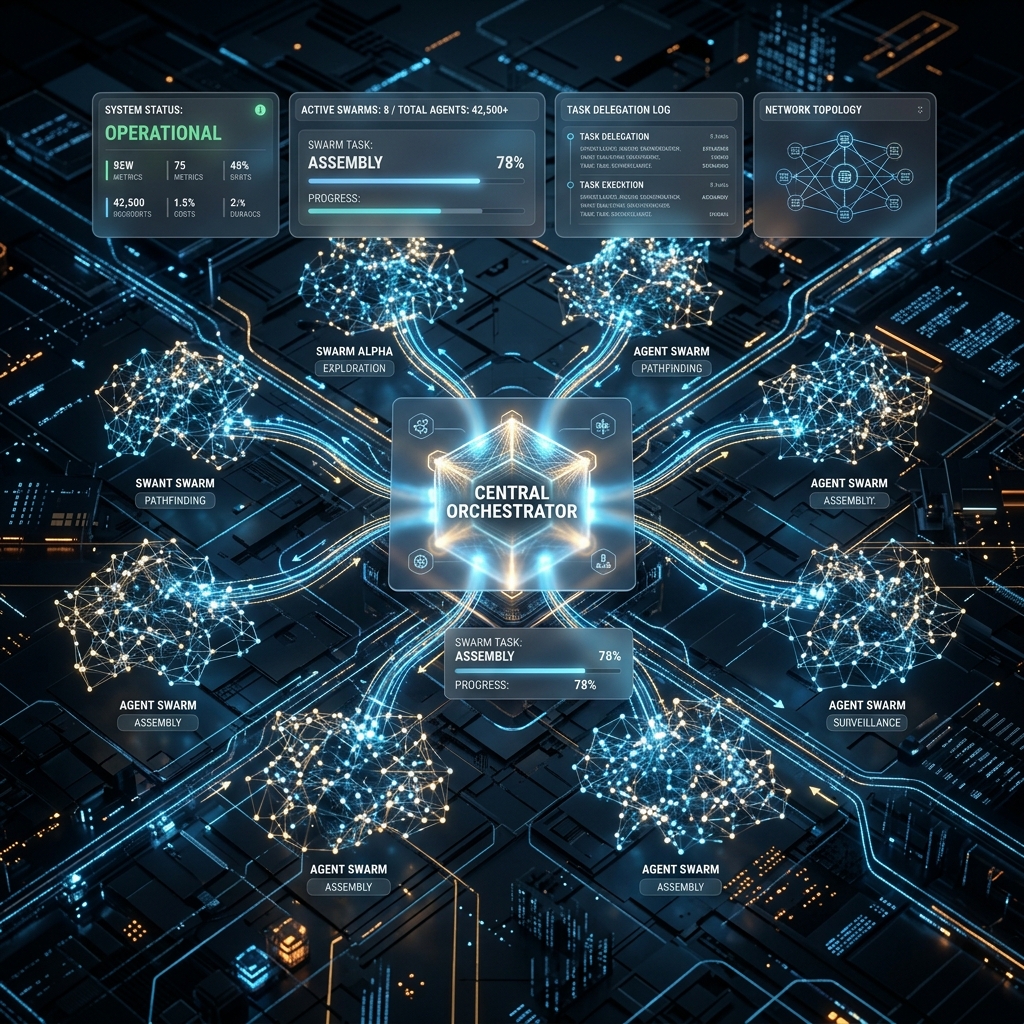
Enterprise automation is undergoing a fundamental paradigm shift. Single-agent LLM loops fracture consistently when confronted with complex, multi-stage business pipelines. The future of operational efficiency is multi-agent orchestration: coordinated networks of specialized agents that delegate, validate, and execute in parallel.
Why Single-Agent Systems Hit Ceilings
Most businesses begin their automation journey with a single-agent approach: one prompt sent to a large language model to handle an entire workflow. This works cleanly for basic tasks, but once a pipeline exceeds three or four decision points, the single-agent model breaks down due to predictable constraints:
- Context Saturation: Complex workflows accumulate excessive historical data, diluting the model’s reasoning capability and leading to ignored instructions.
- Compounding Hallucinations: If the model makes a minor reasoning error in step one, that error propagates and corrupts all downstream activities.
- Lack of Parallelism: Sequential execution means a ten-step process takes ten times longer, causing unacceptable delays in real-time integrations.
The Orchestrator-Specialist-Validator Topology
To overcome these limitations, OmegaAI Systems deploys a modular, three-tier agent swarm architecture designed for maximum reliability:
1. The Orchestrator Node: This supervisor agent receives the incoming operational objective (e.g., “Onboard client and configure CRM”), decomposes it into a structured sequence of subtasks, and dynamically routes each to specialized nodes.
2. Specialist Agents: Narrow-domain expert agents focused exclusively on one task (such as running a database query, parsing a contract PDF, or generating a Slack notification). Because their scope is restricted, their accuracy rates approach 100%.
3. The Validation Layer: A crucial deterministic node that audits the outputs of specialist agents before writing to production systems. It checks schemas, format constraints, and safety guidelines, returning incorrect formats to the specialist for correction.
Designing Deterministic State Machines
A critical rule of enterprise-grade AI automation is treating every multi-agent workflow as a formal state machine. Every transaction must transition through explicit states (e.g., Pending, Validated, Executed, or Failed). If a database write fails, the orchestrator triggers automated rollback loops to prevent partial writes and database corruption.
Operational Leverage at Scale
By delegating manual administration to self-healing, multi-agent swarms, high-growth companies can eliminate back-office bottlenecks completely. Compliance checks, customer data matching, invoicing, and reporting execute autonomously, freeing human teams to focus on creative strategy and relationship building.
Ready to deploy a custom agent swarm in your organization? Connect with our systems architects to design an automated topology tailored to your back-office pipelines.